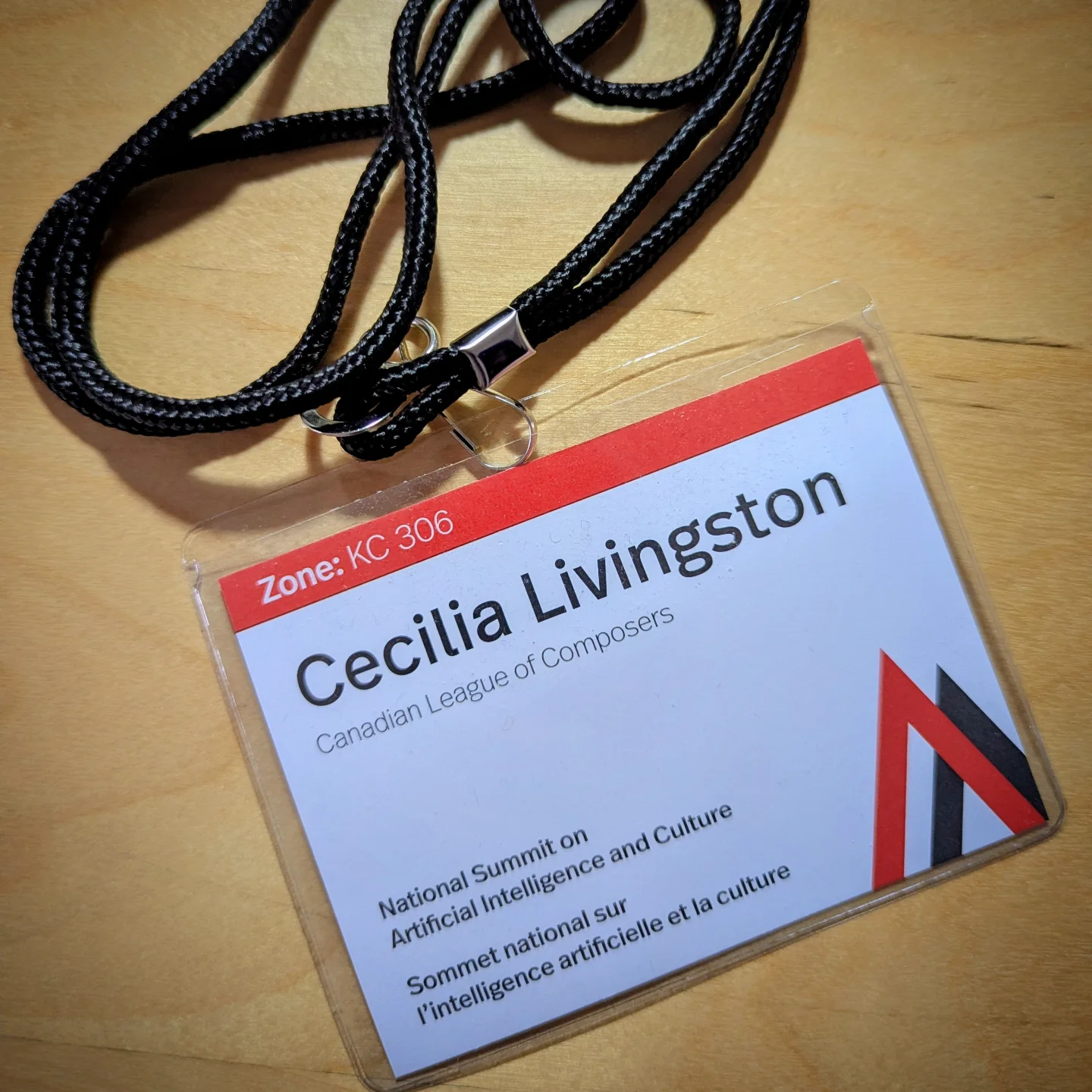
The Department of Canadian Heritage invited 295 leaders from tech, academia, government and the cultural sector for a 3-day conference at the Banff Centre for Arts and Creativity to discuss the future of Canadian culture in the age of artificial intelligence, with The Honorable Marc Miller (Minister of Canadian Identity and Minister responsible for Official Languages) and the Honorable Evan Solomon (Minister of Artificial Intelligence and Digital Innovation; Minister responsible for the Federal Economic Development Agency for Southern Ontario) in attendance.
The Summit presented an excellent opportunity for the CLC to work alongside the Screen Composers Guild of Canada, the Songwriters Association of Canada, la Société professionnelle des auteurs, compositeurs du Québec et des artistes entrepreneurs, SOCAN, and the Coalition for the Diversity of Cultural Expressions (CDCE) to represent artists’ concerns to government: focusing on authorisation, remuneration, and transparency. An opening address by Shani Gwin encouraged participants to reflect on the parallels between current concerns about misinformation and data mining with Indigenous experiences of misinformation and colonization. A powerful video statement by CISAC President Björn Ulvaeus (of ABBA) called for strong protections for creators, and from there the Summit unfolded around three “pillars”, or themes: Build, Protect, Empower. Each pillar was introduced by a keynote address, followed by a panel/roundtable and participant break-out rooms, where facilitated feedback was anonymized for take-back to government.
“Protect” quickly became the overarching theme, with concerns repeatedly raised around
(1) trust between creatives, tech companies, and government;
(2) a potential text and data mining copyright exemption for tech companies, potentially impacting creators’ consent for use of their works, credit when their work is used, and compensation;
(3) cultural sovereignty and protection of Canadian cultural IP.
A powerful speech from SOCAN Chief Legal Officer Andrea Kokonis and CDCE Executive Director Marie-Julie Desrochers called for a licensing system that will protect creators’ intellectual property and revenue streams. Their speech was greeted with loud applause from the participants–though Minister Miller refrained from public comment when later asked if he would rule out a text and data mining exemption. He did, however, state that he does not intend to reopen the Copyright Act, and that creators must be compensated for use of their work.
In line with frequent comments from the participants that the Summit dialogue must continue and thus be responsive to the rapid pace of change in this area, Ministers Solomon and Miller announced a new Advisory Council on AI and Culture at the conclusion of the Summit. This Council will meet every six months, with 12 rotating members (yet to be appointed). A federal AI strategy will be announced shortly, though no exact timeline was given.
The CLC will continue working closely with SOCAN and the other creator groups to ensure that the concerns of composers, sound artists, and all creators remain at the forefront of these policy discussions.
Read more about the Summit format here
https://www.canada.ca/en/canadian-heritage/campaigns/ai-culture-summit.html
Watch Björn Ulvaeus’s opening remarks here
https://www.youtube.com/watch?v=qv1XlJ7ieVo
Read Canadian Heritage’s press release about the Summit and the Advisory Council
https://www.canada.ca/en/canadian-heritage/news/2026/03/leaders-creators-and-innovators-come-together-at-canadas-first-ever-national-summit-on-artificial-intelligence-and-culture.html
Read CDEC’s press release following the conference here
https://cdec-cdce.org/en/publications/summit-ai-culture-banff/